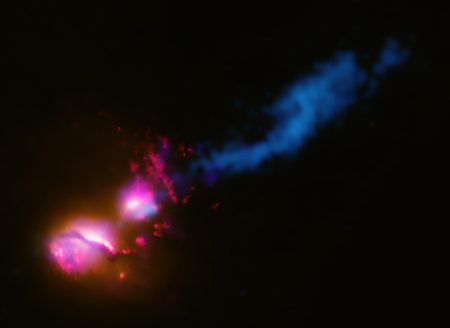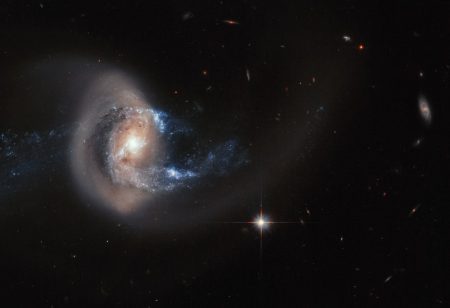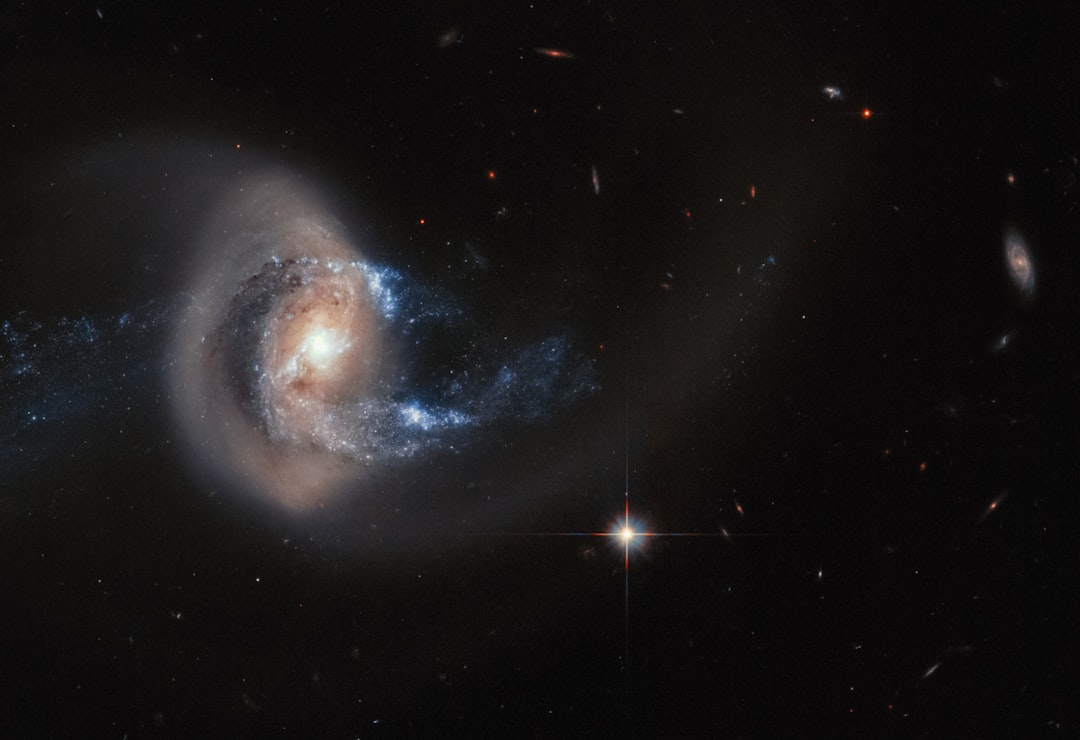
A restless jet emanating from a supermassive black hole in the galaxy VV 340a is actively expelling gas crucial for star formation, new research reveals. This unusual “wobbling black hole jet” phenomenon, observed by astronomers using a suite of advanced telescopes, offers a direct look at how central black holes dramatically reshape their host galaxies.
The interaction between supermassive black holes and their host galaxies is a fundamental process in cosmic evolution. While these colossal objects are known for their immense gravitational pull, many also possess active galactic nuclei (AGN) that launch powerful jets of energy. These jets can profoundly influence a galaxy’s future, often by clearing out the very gas clouds required for new stars to ignite.
Understanding this intricate dance requires detailed observation across multiple wavelengths, allowing scientists to trace the journey of these energetic outflows. The recent study on VV 340a highlights a particularly dynamic scenario, where the jet’s unique motion amplifies its destructive impact, potentially stifling future stellar nurseries across vast cosmic distances.
The mechanics of a wobbling black hole jet
The research, detailed in a study by the American Association for the Advancement of Science (AAAS) and reported by ScienceDaily on January 19, 2026, focuses on VV 340a. This galaxy hosts an actively feeding supermassive black hole, making it an ideal cosmic laboratory.
Astronomers, led by Justin Kader, leveraged instruments like the James Webb Space Telescope (JWST), Keck-II, the Karl G. Jansky Very Large Array, and ALMA to piece together a comprehensive view of this cosmic phenomenon.
These observations revealed that the jet from VV 340a doesn’t simply shoot straight out. Instead, it exhibits a precessional motion, much like a spinning top gently wobbling as it rotates.
This conical movement, observed on kiloparsec scales for the first time in a disk galaxy, allows the jet to interact with a much broader swath of the surrounding gas. This enhanced interaction is key to its efficiency in expelling material from the galaxy.
The team estimated that gas is being ejected at an astonishing rate of approximately 19.4 solar masses per year. This significant loss of material directly impacts the galaxy’s ability to form new stars, as the raw ingredients are continuously stripped away. This finding underscores the profound influence even a relatively weak yet persistent jet can have on galactic evolution.
Stripping star-forming gas: A cosmic consequence
The gas being driven out of VV 340a is not just any gas; it’s highly energized and strongly ionized, a state often referred to as coronal line gas. Typically, this type of gas is found very close to a black hole’s immediate vicinity.
However, in VV 340a, infrared observations from the James Webb Space Telescope were crucial in showing that this coronal gas extends much farther into the galaxy than previously thought. The dust-penetrating capabilities of infrared light were essential for this discovery.
As the wobbling black hole jet propagates outwards, it couples with the galactic gas, heating it to extreme temperatures and pushing it away from the core.
This dual action of heating and removal creates a large-scale galactic outflow, effectively disrupting the supply of cold, dense gas necessary for star birth. Such processes are critical for understanding how galaxies evolve, including our own Milky Way.
According to research from NASA’s Chandra X-ray Observatory, galactic outflows driven by active galactic nuclei are a primary mechanism for regulating star formation and shaping the morphology of galaxies.
The unique precessing nature of the jet in VV 340a amplifies this effect, turning a potentially localized disruption into a widespread galactic stripping event.
The discovery of a wobbling black hole jet actively stripping a galaxy of its star-forming gas provides a compelling case study for galactic evolution. It demonstrates the complex and often violent interplay between supermassive black holes and their host environments.
As telescopes continue to improve, future observations of similar systems will offer even deeper insights into these cosmic processes, helping us understand the ultimate fate of galaxies across the universe.