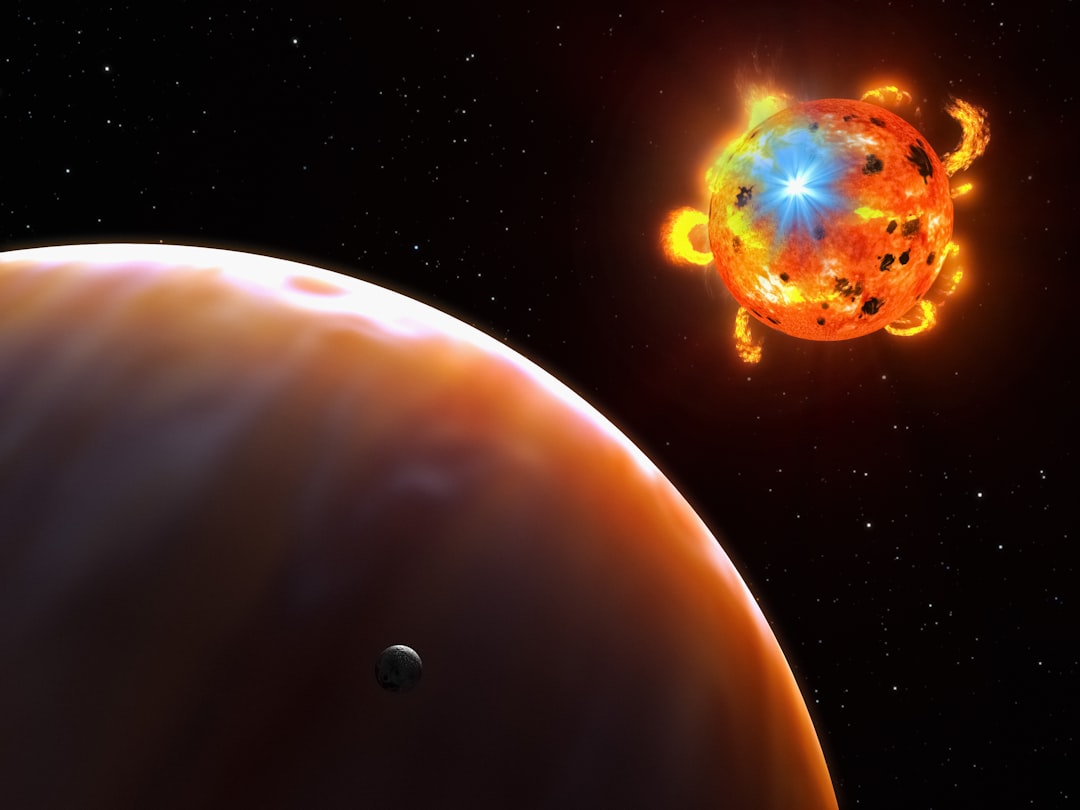
The James Webb Space Telescope has captured unprecedented real-time observations of WASP-121b, an ultra-hot Jupiter, experiencing dramatic exoplanet atmosphere loss. This detailed study, published in Nature Communications, reveals the gas giant is bleeding its atmosphere into space, forming two colossal helium tails, offering new insights into planetary evolution. According to ScienceDaily.com, these observations from NASA’s James Webb Space Telescope mark a significant breakthrough in understanding atmospheric escape.
Astronomers from the University of Geneva and the University of Montreal utilized Webb’s Near-Infrared Spectrograph (NIRISS) to continuously monitor WASP-121b for nearly 37 hours. This extended observation period allowed researchers to track the planet’s atmospheric processes over a full orbit, providing a level of detail previously unattainable through shorter transit studies.
WASP-121b, an exoplanet orbiting its star every 30 hours, is subjected to extreme radiation, heating its atmosphere to thousands of degrees. Such intense conditions cause lighter elements, like hydrogen and helium, to escape the planet’s gravitational pull and drift into space. This phenomenon, known as atmospheric escape, plays a crucial role in shaping a planet’s long-term evolution and composition.
Unveiling the double helium tails
The most striking discovery from Webb’s continuous monitoring was not a single stream of escaping gas, but two distinct and massive helium tails engulfing WASP-121b. One tail trails behind the planet, propelled by stellar radiation and winds, while the other stretches ahead, likely influenced by the star’s gravitational pull. These gas flows extend over a distance more than 100 times the planet’s diameter.
Romain Allart, a postdoctoral researcher at the University of Montreal and lead author, expressed surprise at the duration of the helium escape, noting its complexity. This intricate structure challenges existing numerical models that typically describe simpler, comet-like gas tails. The findings highlight the nuanced physical processes at play between exoplanetary atmospheres and their host stars, pushing the boundaries of current astrophysical understanding.
Implications for planetary evolution
Understanding exoplanet atmosphere loss is vital for deciphering how planets form and evolve. Over millions of years, the steady depletion of atmospheric material can significantly alter a planet’s size, mass, and even its classification. For ultra-hot Jupiters like WASP-121b, this process is particularly intense due to their extreme proximity to their stars, making them natural laboratories for studying atmospheric dynamics.
The ability of the James Webb Space Telescope to conduct such prolonged, detailed observations marks a new era in exoplanetary science. Previous studies were limited to short transits, offering only snapshots of these dynamic events. Continuous tracking provides a comprehensive view, allowing scientists to model these complex interactions with greater accuracy. This data is crucial for refining theories on how planets lose their atmospheres and what remains behind.
This groundbreaking observation by the James Webb Space Telescope not only offers an unparalleled look at an exoplanet actively losing its atmosphere but also underscores the dynamic nature of planetary systems beyond our own. Future research will undoubtedly leverage Webb’s capabilities to explore other exoplanets exhibiting atmospheric escape, further unraveling the diverse evolutionary paths planets can take across the galaxy. The insights gained from WASP-121b will inform our understanding of planetary habitability and the conditions necessary for sustaining an atmosphere.