New research from Washington State University indicates that Europa’s ice may be feeding a hidden ocean beneath its surface, a process that could significantly boost its potential to support life. This groundbreaking study, detailed by ScienceDaily on January 23, 2026, proposes a novel recycling mechanism where nutrient-rich surface ice sinks into the vast subsurface ocean.
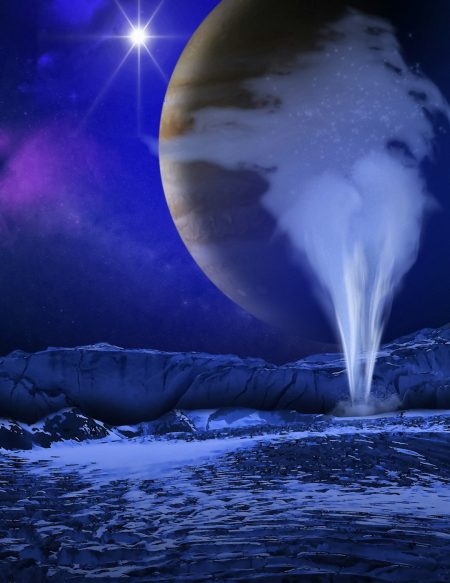
Europa, one of Jupiter’s largest moons, has long captivated scientists due to its immense subsurface ocean, which contains more liquid water than all of Earth’s oceans combined. However, the thick ice shell encasing this ocean has posed a major challenge: how could essential life-supporting nutrients from the radiation-exposed surface ever reach the depths below?
The moon’s surface is constantly bombarded by Jupiter’s intense radiation, creating compounds that could serve as food for microbes. While the existence of these surface nutrients was known, their transport downward remained a puzzle, with most geological activity on Europa being lateral rather than vertical.
How dense ice could feed Europa’s ocean
To address this long-standing habitability problem, researchers Austin Green and Catherine Cooper drew inspiration from a geological process on Earth known as crustal delamination. This terrestrial phenomenon involves sections of Earth’s crust becoming dense enough to detach and sink into the mantle.
Their computer simulations adapted this concept, suggesting that ice on Europa, particularly areas enriched with salts, could become sufficiently dense to break free from surrounding purer ice. This weakened, heavy ice would then slowly descend through the moon’s thick shell.
This process, according to the models, offers a fast and repeatable way for surface materials to reach the ocean. “This is a novel idea in planetary science, inspired by a well-understood idea in Earth science,” stated Austin Green, lead author and postdoctoral researcher at Virginia Tech, in the ScienceDaily report.
Green emphasized that this mechanism “addresses one of the longstanding habitability problems on Europa and is a good sign for the prospects of extraterrestrial life in its ocean.” The simulations, published in The Planetary Science Journal, showed this sinking could occur across various salt levels, provided the surface ice experienced even modest weakening.
Implications for Europa’s life potential
The findings are highly relevant to NASA’s ongoing Europa Clipper mission, which launched in 2024. This spacecraft is specifically designed to investigate Europa’s ice shell, its subsurface ocean, and its overall habitability using advanced scientific instruments.
If verified, this delamination process could mean a constant, reliable supply of nutrients for any potential life forms thriving in Europa’s hidden ocean. This greatly enhances Europa’s standing as one of the most promising locations in our solar system for extraterrestrial life.
Understanding these geological interactions between the surface and the deep ocean is crucial for interpreting data from missions like Europa Clipper. It provides a more complete picture of the moon’s dynamic environment and its capacity to sustain biological activity over geological timescales.
The mission’s data will be vital in confirming whether processes akin to crustal delamination are indeed occurring, offering unprecedented insights into the moon’s internal structure and its potential for life. More information on the mission can be found on NASA’s Europa Clipper website.
This new understanding of how Europa’s ice shell might recycle itself marks a significant step forward in the search for life beyond Earth. It shifts the paradigm, providing a plausible pathway for surface-generated nutrients to reach the moon’s vast, dark ocean.
While challenges remain, the possibility of a dynamically fed, nutrient-rich hidden ocean beneath Europa’s ice makes the prospect of discovering extraterrestrial life there more tangible than ever. Future observations from Europa Clipper will undoubtedly shed more light on this fascinating celestial body.