A distant sun-like star, J0705+0612, abruptly dimmed to a fraction of its normal brightness for nearly nine months, stunning astronomers. Located 3000 light-years from Earth, this unprecedented event, observed from September 2024 to May 2025, was caused by a colossal, metal-filled cloud, suggesting a catastrophic planetary collision.
Such dramatic dimming of a star resembling our Sun is exceptionally rare, challenging previous assumptions about stellar stability. As Nadia Zakamska, a professor of astrophysics at Johns Hopkins University, noted, “Stars like the Sun don’t just stop shining for no reason.” This anomaly prompted an intensive observation campaign.
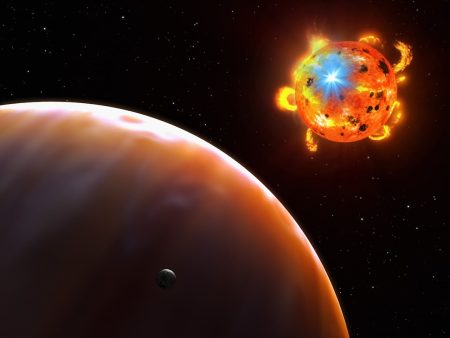
Researchers quickly realized something massive was passing in front of the star. Initial data indicated an enormous, slowly drifting cloud of gas and dust, estimated to span 200 million kilometers across and orbiting about two billion kilometers from J0705+0612. This scale hinted at a profound cosmic event.
The colossal cloud and its mysterious companion
Observations combined with archival data revealed the cloud is gravitationally bound to a secondary object. This companion is estimated to be several times the mass of Jupiter, possibly a giant planet, a brown dwarf, or even a very low-mass star, according to findings reported by ScienceDaily on January 24, 2026.
The exact nature of this companion is crucial. If it’s a star, the cloud forms a circumsecondary disk; if a planet, it’s a circumplanetary disk. Both scenarios are remarkably uncommon, offering a unique opportunity to study the chaotic processes still shaping exoplanetary systems long after their initial formation.
Unveiling metallic winds with GHOST
To analyze the cloud’s composition, astronomers utilized the Gemini High-resolution Optical Spectrograph (GHOST) on the Gemini South telescope in Chile. This powerful instrument, operated by NSF NOIRLab, allowed them to split the starlight into a detailed spectrum, revealing the elements within the obscuring cloud.
The GHOST observations, conducted in March 2025, provided an unprecedented look at the cloud’s internal dynamics. For the first time, scientists directly measured powerful winds of vaporized metals swirling within the disk. Zakamska expressed her excitement, stating the result “exceeded all my expectations.”
These metallic winds offer direct evidence of energetic activity within what could be the remnants of a catastrophic planetary collision. The presence of such a dynamic, metal-rich disk suggests that even ancient star systems can experience violent smashups, reshaping their environments dramatically. Their results were published in The Astronomical Journal.
The dimming of J0705+0612 provides a rare window into the ongoing, chaotic evolution of planetary systems. This discovery highlights that cosmic violence, such as planetary collisions, isn’t confined to the early universe but can occur in mature systems. Future studies will likely focus on pinpointing the exact nature of the companion object and understanding the long-term implications of such profound events.