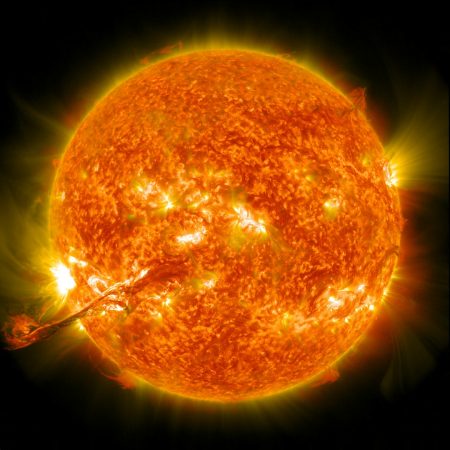
Spacecraft recently achieved an unprecedented solar superstorm observation, capturing the Sun’s NOAA 13664 region over three months in 2024. This joint effort by the ESA’s Solar Orbiter and NASA’s Solar Dynamics Observatory unveiled the evolution of a massive active region, triggering the strongest geomagnetic storms seen on Earth since 2003 and demonstrating the critical need for continuous space weather monitoring.
The collaboration between the European Space Agency’s Solar Orbiter and NASA’s Solar Dynamics Observatory offered a truly unique perspective on the Sun’s dynamic behavior. While Earth-based observatories can only track active regions for about two weeks as the Sun completes its rotation, the Solar Orbiter’s wide orbit allowed for continuous monitoring of NOAA 13664, even when it rotated to the Sun’s far side. This extended coverage, from April to July 2024, provided an invaluable dataset for solar physicists studying extreme space weather events.
This exceptional, prolonged view significantly advanced researchers’ understanding of how magnetic fields drive solar storms. Scientists, including Ioannis Kontogiannis from ETH Zurich and the Istituto ricerche solari Aldo e Cele Daccò (IRSOL), were able to trace the region from its initial emergence on April 16, 2024, through its full evolution and eventual decay after July 18. This 94-day timeline represents the longest continuous series of images ever created for a single active region, marking a profound milestone in solar physics.
Observing extreme space weather
The coordinated observation effort was absolutely critical for this detailed solar superstorm observation. NASA’s Solar Dynamics Observatory provided continuous views from the Earth-Sun line, while the ESA’s Solar Orbiter filled in the crucial observational gaps, diligently observing the Sun’s far side. This powerful combination allowed scientists to track NOAA 13664 for 94 days without interruption, providing unparalleled insights into its growth, twisting, and eventual eruption, as detailed in a recent report by ScienceDaily.
Ioannis Kontogiannis, a leading solar physicist at ETH Zurich, highlighted the immense significance of this achievement, stating, “This is the longest continuous series of images ever created for a single active region: it’s a milestone in solar physics.” Understanding these complex magnetic field dynamics is paramount, as these volatile regions form when highly magnetized plasma rises from the Sun’s interior and violently breaks through its surface, becoming unstable and explosively releasing energy as intense solar flares and massive plasma ejections into space.
Real-world impacts of solar superstorms
Beyond the spectacle of vibrant auroras, the real-world impacts of severe space weather extend significantly into our modern technological infrastructure. The powerful geomagnetic storms triggered by NOAA 13664 in May 2024 demonstrably disrupted power grids, severely interfered with critical communication systems, and notably increased radiation exposure for aircraft crews on long-haul flights. Satellites, which are the backbone of much global connectivity, are particularly vulnerable; a stark example occurred in February 2022, when 38 Starlink satellites were tragically lost just days after launch due to unexpectedly heightened solar activity.
Louise Harra, a distinguished professor at ETH Zurich, further emphasized the broader, often overlooked, implications, noting with concern, “Even signals on railway lines can be affected and switch from red to green or vice versa. That’s really scary.” Modern digital agriculture also faced severe and widespread disruptions in May 2024, with essential signals from satellites, drones, and ground-based sensors compromised, leading to lost working days for farmers and considerable economic losses from critical crop failures across affected regions.
The comprehensive solar superstorm observation of NOAA 13664 profoundly underscores the Sun’s immense and often unpredictable influence on Earth and its increasingly sophisticated technological systems. As our global society becomes more reliant on space-based assets and sensitive ground infrastructure, continued international collaboration in advanced solar monitoring and research remains absolutely vital. Future efforts will undoubtedly focus on refining predictive models and developing robust mitigation strategies, ensuring better preparedness for these powerful, yet inherently unpredictable, cosmic events that shape our environment.