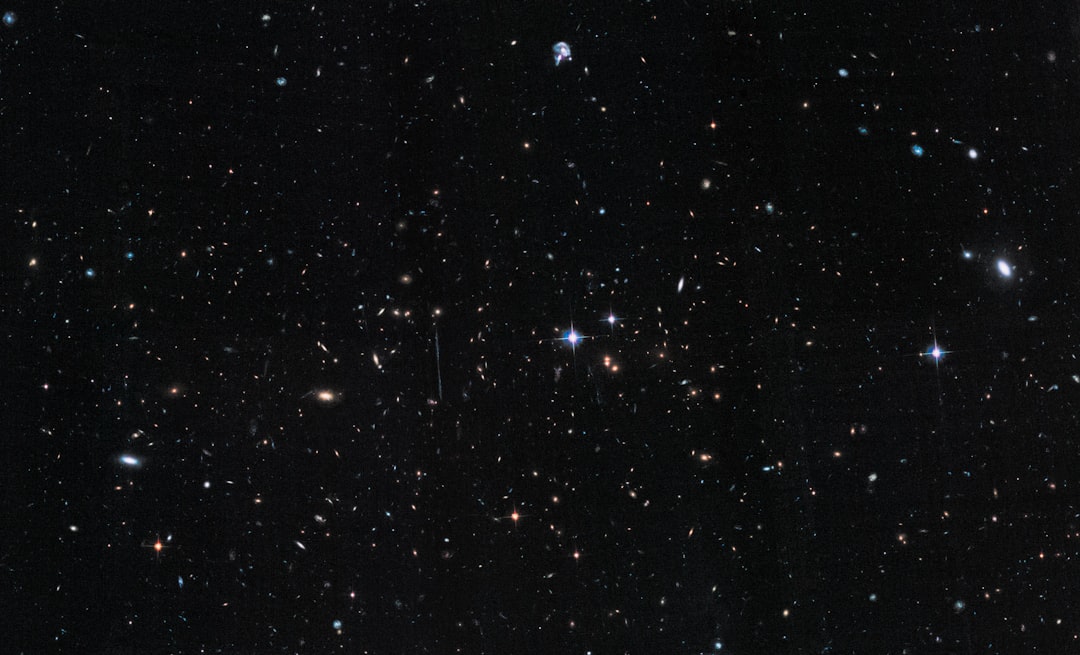
Astronomers have recently unveiled Cloud-9, a groundbreaking discovery by the Hubble Space Telescope: the first confirmed ghost galaxy made of dark matter, entirely devoid of stars. This celestial anomaly, detailed by the European Space Agency and reported on ScienceDaily, provides a critical window into the universe’s earliest and darkest building blocks, challenging long-held assumptions about cosmic evolution.
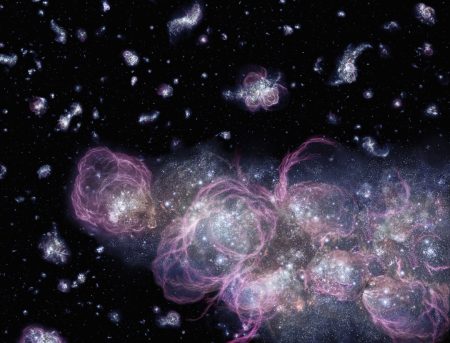
For decades, cosmologists theorized about “failed galaxies”—primordial structures rich in dark matter and gas that never ignited star formation. Cloud-9, located approximately 2,000 light-years from Earth, offers the first direct observational evidence of such an object. Its existence validates complex models of the early universe, where not all gas clouds successfully transformed into luminous galaxies.
This remarkable finding, a collaboration involving NASA and ESA, highlights the ongoing quest to understand the universe’s invisible components. It underscores that much of cosmic history might be hidden within these dark, quiescent structures, awaiting detection by advanced instruments like Hubble’s Advanced Camera for Surveys.
Unveiling a ghost galaxy made of dark matter
The identification of Cloud-9 as a true dark matter galaxy was a meticulous process. Initial observations from ground-based telescopes, specifically the Very Large Array (VLA), detected a diffuse cloud of neutral hydrogen (H I) gas. However, the critical step involved the Hubble Space Telescope, whose superior sensitivity was needed to confirm the absence of stars.
According to Gagandeep Anand of the Space Telescope Science Institute (STScI), lead author of the research, “Before we used Hubble, you could argue that this is a faint dwarf galaxy that we could not see with ground-based telescopes. They just didn’t go deep enough in sensitivity to uncover stars.” Hubble’s Advanced Camera for Surveys definitively showed no stars within Cloud-9’s boundaries, ruling out the possibility of a hidden, faint dwarf galaxy.
This starless object, formally categorized as a Reionization-Limited H I Cloud (RELHIC), is a relic from the early universe. Alejandro Benitez-Llambay from the University of Milano-Bicocca, principal investigator for the program, emphasized that “seeing no stars is what proves the theory right. It tells us that we have found in the local Universe a primordial building block of a galaxy that hasn’t formed.” This confirms that RELHICs are indeed dark matter structures that never gathered enough gas to trigger star formation, as ESA’s Hubble news portal also detailed.
Implications for cosmic evolution
The discovery of Cloud-9, this unique dark matter galaxy, provides unprecedented insight into the vast, unseen components of the cosmos. Scientists estimate that Cloud-9 contains roughly 5 billion solar masses, with neutral hydrogen gas accounting for about 1 million solar masses. This significant mass disparity strongly suggests that dark matter constitutes the overwhelming majority of its composition, balancing the immense gravitational pull.
Andrew Fox of AURA/STScI for ESA noted, “This cloud is a window into the dark Universe. We know from theory that most of the mass in the Universe is expected to be dark matter, but it’s difficult to detect this dark material because it doesn’t emit light. Cloud-9 gives us a rare look at a dark-matter-dominated cloud.” Understanding such objects is crucial for refining models of dark matter distribution and its role in galaxy formation.
The existence of RELHICs like Cloud-9 implies that our galactic neighborhood might harbor many other “abandoned houses,” as Rachael Beaton of STScI poetically described them. These objects offer a unique opportunity to study the conditions of the early universe, as they have remained largely unchanged, preserving primordial characteristics that are often obscured by stellar activity in luminous galaxies. Further research will undoubtedly seek to identify more of these elusive Hubble discoveries.
The confirmation of Cloud-9 as a starless, dark matter-dominated object marks a significant milestone in astronomy. It not only validates theoretical predictions about failed galaxies but also opens new avenues for exploring the universe’s dark sector. Future telescopes, with even greater sensitivity, will likely uncover more of these ghost galaxies, painting a more complete picture of cosmic evolution and the mysterious nature of dark matter.