Astronomers have identified a rare quasar in the early universe, revealing a black hole growing way too fast. This supermassive object devours matter 13 times faster than its theoretical ‘speed limit,’ while simultaneously blasting bright X-rays and a powerful radio jet. This surprising combination challenges many existing astrophysical models.
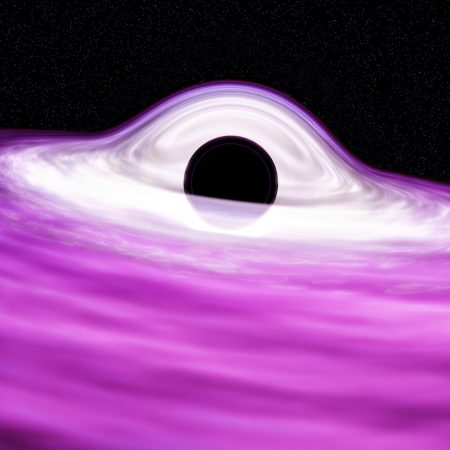
The discovery, by an international team from Waseda and Tohoku Universities using the Subaru Telescope, provides crucial insight. Supermassive black holes, millions to billions of times the Sun’s mass, reside at galaxy centers. They grow by drawing in gas, forming an accretion disk and energizing an X-ray emitting corona. This process also sometimes produces bright radio jets.
A major question in astrophysics is how some cosmic giants became so massive so early. One proposed explanation for rapid growth is super-Eddington accretion. Under standard conditions, radiation from infalling material pushes outward, limiting growth. This theoretical cap is the Eddington limit. Yet, extreme environments might allow black holes to exceed this for brief periods.
Defying black hole growth limits
Researchers used the Subaru Telescope’s MOIRCS to investigate early universe growth. Tracking gas motion and Mg II emission, they estimated the black hole’s mass. This supermassive black hole, from 12 billion years ago, accretes matter roughly 13 times the Eddington limit, based on X-ray measurements. Such rapid growth challenges current theoretical boundaries.
This object’s multi-wavelength behavior is unique. Many models predict super-Eddington growth weakens X-ray emission and suppresses jet activity. Yet, this quasar remains bright in X-rays and strongly radio-loud simultaneously. This suggests the black hole is growing at an extreme pace while maintaining an active corona and a powerful jet. Current theories struggle to explain this combination.
Implications for galaxy evolution
The team suggests this quasar is in a short transitional period, perhaps after a sudden gas influx. Rapid material increase drives the black hole into a super-Eddington state. For a limited time, the X-ray corona and radio jet remain highly energized before settling. This offers a rare chance to study dynamic black hole growth in the early Universe, crucial for explaining rapid formation.
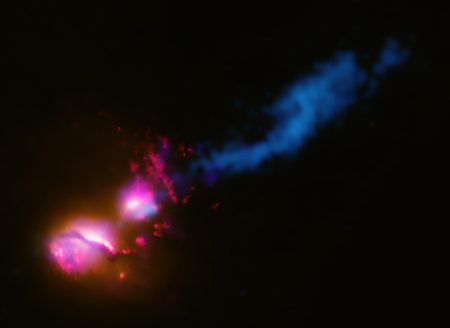
The strong radio signal means the jet affects its surroundings. These jets can heat or disrupt gas within the host galaxy, influencing star formation and shaping how galaxies and their central black holes evolve. The link between super-Eddington growth and jet-driven feedback is not fully understood. This quasar offers a valuable reference for testing new ideas and refining galaxy evolution models.
This unusual quasar, with a black hole growing way too fast and defying expectations, offers a unique cosmic laboratory. Its existence challenges prevailing theories on black hole accretion and galaxy co-evolution. Future observations, perhaps from the James Webb Space Telescope, will be crucial to unraveling the mysteries of these early universe giants and their profound cosmic impact.