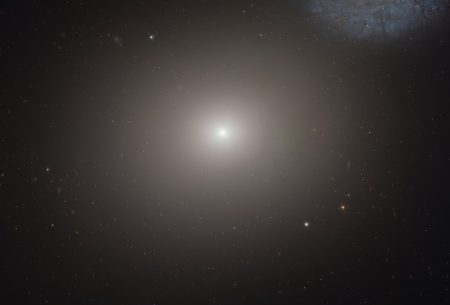
Astronomers using NASA’s Hubble Space Telescope have uncovered a small, previously hidden companion star carving a dense wake through Betelgeuse’s vast atmosphere. This discovery, detailed in findings accepted for publication in The Astrophysical Journal, finally explains the red supergiant’s perplexing and long-running changes in brightness and atmospheric behavior, including its dramatic dimming in 2020.
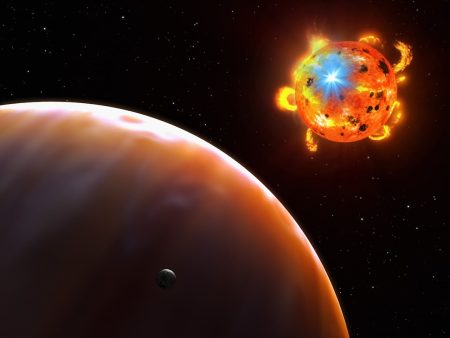
The companion star, named Siwarha, creates swirling trails of dense gas as it orbits through Betelgeuse’s outer layers. Researchers from the Center for Astrophysics | Harvard & Smithsonian (CfA) led the study, integrating nearly eight years of observations from Hubble and various ground-based observatories. This breakthrough resolves one of astronomy’s enduring puzzles surrounding the variable star.
Betelgeuse, located approximately 650 light-years from Earth in the constellation Orion, is a red supergiant of immense scale, large enough to contain over 400 million Suns. Its proximity and size make it a crucial target for understanding the life cycle of massive stars, how they shed material, and their eventual supernova explosions. The newly confirmed presence of Siwarha offers critical insights into these processes.
The stellar wake and Betelgeuse’s strange variability
The influence of Siwarha was identified by meticulously measuring subtle changes in Betelgeuse’s light over an extended period. These long-term observations, as reported by ScienceDaily on January 10, 2026, revealed the effects of a companion star that had been suspected but never definitively confirmed until now. As Siwarha moves through Betelgeuse’s outer atmosphere, it generates a dense stream of gas, disrupting the surrounding material and forming a visible wake.
This detection provides a robust explanation for the observed behavior of Betelgeuse. Andrea Dupree, an astronomer at the CfA and lead author of the study, highlighted the significance: “It’s a bit like a boat moving through water. The companion star creates a ripple effect in Betelgeuse’s atmosphere that we can actually see in the data.” She added that this marks the first time direct signs of this wake have been observed, solidifying the presence of Betelgeuse’s hidden companion. Scientists noted a clear 2,100-day cycle in Betelgeuse’s behavior, consistent with Siwarha’s orbital period.
Unraveling the mystery of the red supergiant
Astronomers have monitored Betelgeuse for decades, tracking its brightness and surface changes in an effort to comprehend its unpredictable nature. Public interest surged in 2020 when the star unexpectedly dimmed significantly, an event described as a stellar “sneeze.” This new research provides a compelling explanation for such phenomena by linking them to the companion’s interaction with the supergiant’s atmosphere.
By combining data from the Hubble Space Telescope with observations from ground-based facilities like the Fred Lawrence Whipple Observatory and the Roque de Los Muchachos Observatory, the research team identified repeating patterns in Betelgeuse’s behavior. These patterns, including shifts in the star’s spectrum and the motion of gas in its outer atmosphere, are directly attributable to the dense wake formed by Siwarha. This comprehensive approach underscores the power of multi-observatory astronomy in solving complex stellar mysteries, offering new perspectives on stellar evolution and binary systems.
The confirmation of Siwarha’s existence and its profound impact on Betelgeuse’s atmosphere offers a clearer understanding of how red supergiants evolve and shed mass. This insight is crucial for predicting the eventual fate of these colossal stars, including their dramatic supernova explosions. Future observations will undoubtedly focus on further characterizing Siwarha and its long-term influence on its giant companion, providing valuable data for stellar models.