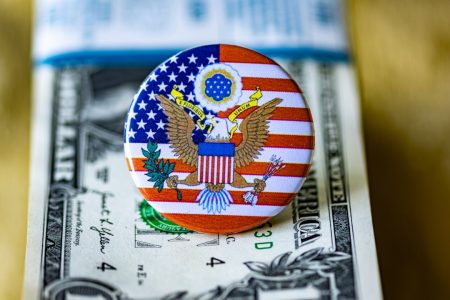
Cathie Wood, the prominent CEO of Ark Invest, recently suggested the United States government might consider accumulating a national bitcoin reserve, echoing the historical role of gold in safeguarding national wealth. This bold forecast, emerging amidst shifting global economic dynamics, highlights a growing debate over the future of sovereign assets and monetary policy.
Wood’s perspective, widely reported in financial media including The Block, positions bitcoin as a potential hedge against inflation and a strategic asset in an increasingly volatile geopolitical landscape. Her firm, known for its focus on disruptive innovation, has long championed cryptocurrencies, particularly bitcoin, as a revolutionary technology with significant long-term value.
The idea of a sovereign nation holding bitcoin is not entirely new, but the suggestion that the US, with its dominant dollar, might explore such a move adds significant weight to the discussion. This comes as central banks globally grapple with rising inflation and the need for diversified reserves beyond traditional fiat currencies and gold.
The strategic case for a US national bitcoin reserve
The concept of a US national bitcoin reserve stems from several compelling arguments put forth by advocates like Cathie Wood. Firstly, bitcoin’s finite supply, capped at 21 million coins, presents it as a deflationary asset, a stark contrast to fiat currencies that can be printed infinitely. This scarcity offers a potential hedge against the devaluation of traditional currencies, a concern increasingly voiced by economists and investors.
Secondly, geopolitical tensions and the weaponization of financial systems have prompted nations to seek alternative, unseizable assets. Bitcoin, with its decentralized and permissionless nature, could theoretically offer a neutral reserve asset less susceptible to political interference or sanctions. According to a report from the Council on Foreign Relations, the advent of digital currencies challenges traditional notions of financial sovereignty, making assets like bitcoin attractive for strategic diversification.
Furthermore, the digital nature of bitcoin aligns with the ongoing global shift towards a digital economy. Holding a significant digital asset could position the US at the forefront of financial innovation, potentially influencing future global monetary standards. This forward-thinking approach could be crucial for maintaining economic leadership in a rapidly evolving technological landscape.
Challenges and implications for dollar supremacy
While the prospect of a US national bitcoin reserve presents intriguing opportunities, it also raises significant challenges and implications, particularly concerning the dollar’s long-standing global supremacy. For decades, the US dollar has served as the world’s primary reserve currency, a status that grants the US considerable economic and geopolitical leverage. Introducing a new reserve asset, especially one as volatile and nascent as bitcoin, could be perceived as a tacit acknowledgment of the dollar’s potential weakening.
Critics argue that bitcoin’s price volatility makes it an unsuitable asset for national reserves, which typically prioritize stability and liquidity. However, proponents counter that as adoption grows and the market matures, volatility is likely to decrease. The regulatory landscape also remains a significant hurdle; a clear legal framework for holding and managing such a reserve would be essential. A speech by Federal Reserve Chair Jerome Powell in 2023 highlighted the ongoing efforts to understand and regulate digital assets, indicating the cautious approach of monetary authorities.
Ultimately, any move towards a US national bitcoin reserve would represent a monumental shift in financial strategy, signaling a profound belief in the long-term viability and strategic importance of digital assets. It would undoubtedly spark intense debate among policymakers, economists, and the public, reshaping discussions about national security, economic stability, and the future of global finance.