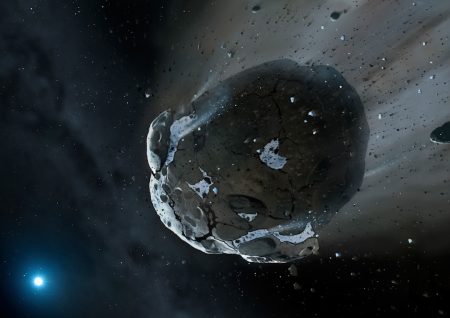
Astronomers recently observed a spectacular event around the star Fomalhaut, where what initially appeared to be a distant planet was, in fact, the glowing aftermath of a massive space collision between giant celestial bodies. This unprecedented observation, detailed by researchers, challenges long-held beliefs about the frequency of such violent impacts in young star systems.
Located merely 25 light-years from Earth, Fomalhaut is a relatively young star, approximately 440 million years old, offering scientists a unique laboratory to witness planetary formation in action. Its age mirrors a tumultuous period in our own solar system’s history, a time when countless planetesimals were continuously crashing and coalescing.
For years, a bright object near Fomalhaut’s broad debris disk, dubbed Fomalhaut b, was celebrated as the first directly imaged exoplanet at optical wavelengths by NASA’s Hubble Space Telescope. However, as the object slowly faded over a decade, subsequent analysis revealed a more dramatic truth: it was not a stable world, but a transient cloud of dust born from a colossal impact.
Unveiling the enigma of Fomalhaut’s cosmic impacts
The groundbreaking discovery, reported by the University of California – Berkeley, involved astronomers directly imaging the aftermath of two enormous collisions around Fomalhaut within just two decades – one in 2004 and another in 2023. Paul Kalas, an adjunct professor of astronomy at UC Berkeley and lead author of the study, noted, “We just witnessed the collision of two planetesimals and the dust cloud that gets spewed out of that violent event, which begins reflecting light from the host star.”
These observations, detailed in a forthcoming paper in the journal Science, represent the first time scientists have directly captured such large-scale impacts beyond our solar system. The sheer brightness of the events suggests the colliding bodies were at least 60 kilometers (37 miles) wide, significantly larger than the asteroid that caused the dinosaur extinction on Earth. This data challenges the previous assumption that such massive impacts are exceedingly rare, perhaps occurring only once every 100,000 years during planet formation.
Reshaping theories of planet formation
The Fomalhaut system offers an unparalleled “natural laboratory” to study the dynamics of planetesimal collisions, providing a direct glimpse into the chaotic processes that forge planetary systems. The misidentification of Fomalhaut b as a planet highlights the deceptive nature of these transient dust clouds, which can mimic stable celestial bodies before dissipating. Kalas explained, “It’s masquerading as a planet because planets also look like tiny dots orbiting nearby stars.”
The frequency of these observed events suggests that violent impacts might be more common in young star systems than previously theorized. This new perspective, as highlighted by a ScienceDaily.com report from January 7, 2026, implies that the early stages of planet formation are potentially far more dynamic and destructive, with small worlds constantly being cratered, destroyed, and reassembled. It forces a re-evaluation of models that describe how gas and dust coalesce into planets over hundreds of millions of years.
The revelations from Fomalhaut compel a deeper understanding of planetary evolution, underscoring that the birth of planets is a violent, chaotic process marked by frequent, colossal collisions. This ongoing cosmic drama provides invaluable insights into the origins of our own solar system and hints at the turbulent beginnings of countless other worlds yet to be discovered across the cosmos.