For years, strange red dots in James Webb Space Telescope images puzzled astronomers, but new research finally offers an explanation: these mysterious cosmic anomalies are young black holes caught in a rapid growth spurt. Scientists at the University of Copenhagen identified these objects, shedding light on the early universe’s violent phase and how supermassive black holes emerged so early in cosmic history.
Since the James Webb Space Telescope began scientific operations, its images of the distant universe have revealed unexpected phenomena. Among stars and galaxies, small, unexplained red points of light emerged, defying existing models of the early cosmos. These “little red dots” appeared during a period when the universe was only a few hundred million years old, seemingly vanishing about a billion years later. Their brief, intense presence sparked a major cosmic mystery.
Initially, one theory suggested these dots were unusually massive galaxies, bright enough to be detected across 13 billion years. However, this idea conflicted with current understanding of galaxy formation, as such large structures should not have existed so soon after the Big Bang. This discrepancy pushed researchers to seek alternative explanations for these peculiar observations from the James Webb.
Unraveling the mystery of early black holes
After two years of extensive analysis of Webb’s data, researchers at the Niels Bohr Institute’s Cosmic Dawn Centre in Copenhagen reached a groundbreaking conclusion. The red dots, they found, are powered by black holes, the universe’s most extreme objects, providing a rare glimpse into the formation and initial growth of these colossal entities. Their findings were prominently published in the journal Nature on January 14.
Professor Darach Watson, a lead author of the study, explained the phenomenon: “The little red dots are young black holes, a hundred times less massive than previously believed, enshrouded in a cocoon of gas, which they are consuming in order to grow larger.” He added, “This process generates enormous heat, which shines through the cocoon.”
“This radiation through the cocoon is what gives little red dots their unique red color.” This discovery, as reported by ScienceDaily, challenges prior assumptions about the mass of these early black holes, needing no ‘completely new types of events’ to explain them.
These newly identified objects, though among the smallest black holes observed, are still immense by earthly standards, weighing up to 10 million times the mass of the Sun. Their rapid growth is fueled by a process Professor Watson described as “messy eating.”
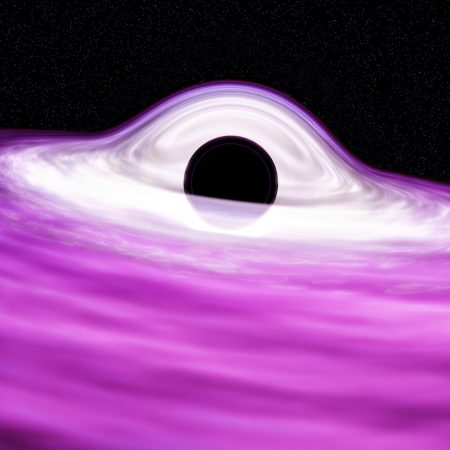
As gas falls towards a black hole, it spirals into a superheated disk, generating millions of degrees of temperature and intense light. However, only a small fraction is swallowed; most is blown back out from the poles as intense radiation, preventing it from being consumed.
Implications for supermassive black hole formation
The identification of these energetic, rapidly growing black holes in the early universe provides a critical piece in the puzzle of how supermassive black holes formed. Every large galaxy, including our own Milky Way, harbors a supermassive black hole at its core, with masses millions of times that of the Sun. The rapid appearance of such colossal objects just a few hundred million years after the Big Bang has long baffled cosmologists.
Understanding these early “messy eaters” helps explain how such immense structures could have emerged so quickly. Their intense consumption and radiative feedback mechanisms suggest a violent and dynamic period of growth, allowing them to accumulate mass far faster than previously modeled. This insight from the James Webb’s red dots data offers a direct observational link to the progenitors of the supermassive black holes we see today, filling a significant gap in our cosmic evolutionary timeline.
The explanation for James Webb’s red dots marks a significant leap in astrophysics, offering direct evidence of rapidly growing, young black holes in the universe’s infancy. This revelation not only resolves a persistent cosmic mystery but also reshapes our understanding of black hole evolution and the formation of galactic centers. Future observations with the JWST will likely refine these models, providing even deeper insights into the violent, yet formative, processes that shaped the cosmos we inhabit.