
A simple electroplating technique, reminiscent of an old jeweler’s trick, is poised to revolutionize nuclear timekeeping, potentially unlocking ultra-precise clocks that function independently of GPS. This breakthrough, reported by a UCLA-led team, promises to redefine how we measure time and navigate in challenging environments like deep space or underwater.
For decades, physicists have sought to harness radioactive thorium nuclei for next-generation clocks, a pursuit that intensified after a UCLA team achieved controlled photon absorption and release in thorium-229. Despite this milestone, a critical limitation persisted: the scarcity of thorium-229, found only in weapons-grade uranium, with an estimated 40 grams available globally for research.
Previous efforts to stabilize thorium-229 involved complex, thorium-intensive methods, specifically embedding the isotope in delicate fluoride crystals. This approach, while effective, consumed significant amounts of the rare material and presented substantial fabrication challenges, hindering the widespread adoption of this transformative technology.
From delicate crystals to robust steel
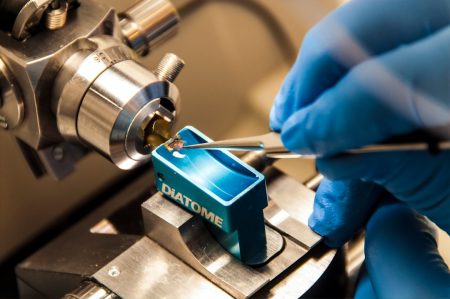
This new era in precision timekeeping arrives through a surprisingly straightforward method. An international collaboration, spearheaded by UCLA physicist Eric Hudson, bypassed the complex crystal fabrication by electroplating a minuscule layer of thorium onto stainless steel. This technique, commonly used in jewelry making since the early 1800s, employs an electric current to coat one metal surface with another.
The team’s postdoctoral researcher, Ricky Elwell, highlighted the dramatic shift from 15 years of intricate crystal development to this simple, inexpensive process. “We did all the work of making the crystals because we thought the crystal had to be transparent for the laser light to reach the thorium nuclei,” Elwell explained, noting that the crystals were “really challenging to fabricate” and required at least one milligram of thorium. The new method uses 1,000 times less thorium.
This innovative approach stems from a re-evaluation of a long-held scientific assumption. Researchers previously believed thorium needed to be encased in a transparent material for laser excitation. The success of electroplating, however, demonstrates that this transparency is not a prerequisite, opening avenues for more robust and practical nuclear clock designs, as detailed in a study published in Nature.
The profound implications for precision and navigation
The implications of this simplified technique for nuclear timekeeping are far-reaching. These nuclear clocks promise vastly greater precision than current atomic clocks, offering unparalleled accuracy for various applications. Their ability to operate without GPS signals makes them invaluable for navigation in environments where satellite signals are unavailable or unreliable.
Imagine submarines navigating deep oceans or spacecraft journeying through interstellar voids with absolute precision, unreliant on external signals. Beyond these specialized uses, the technology could integrate into critical infrastructure such as power grids and cell phone towers, enhancing their stability and synchronization. The potential even extends to everyday devices, with the prospect of nuclear clocks shrinking to fit into phones or wristwatches. This advancement, sourced from www.sciencedaily.com, represents a fundamental shift in how we conceive of and utilize time.
This elegant solution, drawing inspiration from a centuries-old industrial technique, effectively overcomes the scarcity and complexity barriers that once limited nuclear clock development. By making ultra-precise timekeeping more accessible and robust, this breakthrough not only paves the way for a new generation of timing systems but also promises to transform navigation, communication, and fundamental physics research, challenging long-standing scientific paradigms.