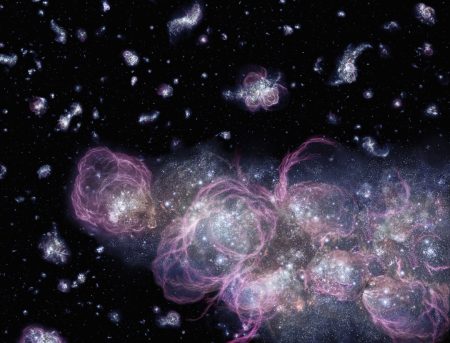
Astronomers have just unveiled a breathtaking new view of the Milky Way in unprecedented radio colors, exposing hidden star births, stellar deaths, and vast galactic structures like never before. This groundbreaking image, detailed on ScienceDaily.com, offers a fresh perspective on our home galaxy’s dynamic processes.
The intricate tapestry of our galaxy, often obscured by dust and gas in visible light, now comes into sharp focus through low-frequency radio waves. This innovative approach allows scientists to peer through the cosmic veil, distinguishing between regions where new stars ignite and where ancient suns have met their dramatic ends. It marks a significant leap in understanding the celestial mechanics governing the Milky Way’s evolution.
Developed by researchers at the International Centre for Radio Astronomy Research (ICRAR), this project leveraged years of observational data and supercomputing power. The resulting image is not merely a pretty picture; it is a profound scientific tool, providing richer detail and wider coverage than any previous low-frequency radio map of our galaxy.
Unveiling hidden stellar life cycles
This vibrant new panorama, meticulously crafted by Silvia Mantovanini, a PhD student at Curtin University’s node of ICRAR, represents a monumental computational effort. Mantovanini dedicated 18 months and approximately one million CPU hours on supercomputers at the Pawsey Supercomputing Research Centre to process data from two extensive sky surveys: GLEAM and GLEAM-X. These surveys, conducted with the Murchison Widefield Array (MWA) telescope in Western Australia, provided the raw radio signals.
The advancements in this latest rendering are substantial. It boasts double the resolution, ten times the sensitivity, and twice the sky coverage compared to earlier GLEAM images. “This vibrant image delivers an unparalleled perspective of our Galaxy at low radio frequencies,” Mantovanini stated, as reported by ScienceDaily. “It provides valuable insights into the evolution of stars, including their formation in various regions of the Galaxy, how they interact with other celestial objects, and ultimately their demise.”
Mapping supernova remnants and star nurseries
One of the most compelling aspects of these new Milky Way radio colors is their ability to differentiate between active star-forming regions and the remnants of colossal stellar explosions. Astronomers can now clearly identify vast red circles representing supernova remnants, the expanding clouds of gas left after a star’s violent death. Conversely, smaller blue regions pinpoint stellar nurseries where new stars are actively being born.
Associate Professor Natasha Hurley-Walker, principal investigator of the GLEAM-X survey, emphasized the image’s significance for galactic structure studies. “This low-frequency image allows us to unveil large astrophysical structures in our Galaxy that are difficult to image at higher frequencies,” she noted. This breakthrough also offers fresh clues about pulsars, rapidly spinning remnants of massive stars, by analyzing their brightness across different radio frequencies.
The detailed insights provided by these new radio colors are set to reshape our understanding of the Milky Way’s dynamic history and future. This milestone in radio astronomy paves the way for even more profound discoveries, particularly with the advent of next-generation instruments like the SKA-Low telescope. The ability to map our galaxy with such clarity ensures that the study of stellar evolution and galactic architecture will continue to yield fascinating revelations for decades to come.