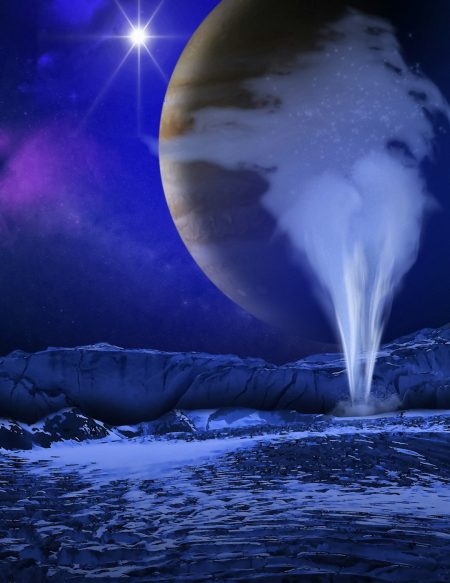
A recent study from Washington University in St. Louis suggests that while Jupiter’s moon Europa likely harbors a vast subsurface ocean, its seafloor may lack the geological activity needed to support life, challenging long-held hopes for extraterrestrial habitability.
For decades, Europa has captivated scientists as a prime candidate for life beyond Earth, primarily due to compelling evidence of its immense liquid water ocean beneath a thick ice shell. This new research, published in Nature Communications, re-evaluates the energy sources available within this enigmatic moon.
Led by Associate Professor Paul Byrne, the team’s calculations indicate a calm, cold, and largely inactive seafloor, painting a less optimistic picture for the complex chemical processes vital for life as we know it. The findings, as reported by ScienceDaily, offer a crucial re-evaluation of Europa’s potential for sustaining Europa life.
Unpacking Europa’s geological inactivity
The research team meticulously modeled Europa’s size, internal structure, and the gravitational pull exerted by Jupiter. Their findings reveal little evidence for tectonic movement, hydrothermal vents, or other energy sources typically linked to habitable environments on Earth’s ocean floor.
Paul Byrne emphasized the implications of these findings for potential exploration. “If we could explore that ocean with a remote-control submarine, we predict we wouldn’t see any new fractures, active volcanoes, or plumes of hot water on the seafloor,” Byrne stated. “Geologically, there’s not a lot happening down there. Everything would be quiet.”
This stark contrast to Earth’s geologically active seafloors, where hydrothermal vents teem with unique life forms thriving on chemical energy, raises significant questions. On a frozen world like Europa, this lack of activity could point to an ocean without the necessary energy gradients for complex ecosystems to emerge or sustain themselves.
Tidal forces and the cooled core
A key factor in planetary geology is tidal heating, generated by the gravitational pull of a larger body. While Jupiter’s innermost large moon, Io, experiences intense tidal forces that drive constant volcanic eruptions, Europa’s orbit is more stable and farther from Jupiter.
This orbital difference translates to significantly weaker tidal forces acting on Europa, reducing their ability to generate internal heat and drive geological activity. Furthermore, the study suggests Europa’s rocky core likely cooled long ago, unlike Earth’s still-hot interior, which contributes to its geological dynamism.
“Europa likely has some tidal heating, which is why it’s not completely frozen,” Byrne explained. “But we don’t see any volcanoes shooting out of the ice today like we see on Io, and our calculations suggest that the tides aren’t strong enough to drive any sort of significant geologic activity at the seafloor.” He concluded that this lack of seafloor energy makes the presence of current Europa life unlikely.
While this study tempers expectations for Europa life, it refines our understanding of planetary habitability and the specific conditions required for life beyond Earth. Future missions, like NASA’s Europa Clipper, will provide direct observations and crucial data to confirm or challenge these models, guiding the ongoing search for life across our solar system.