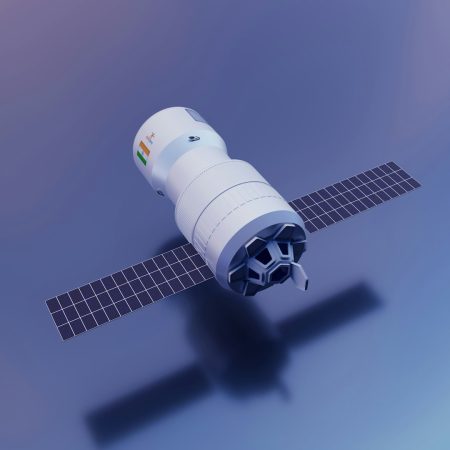
NASA’s ambitious Gateway Lunar Space Station, slated for launch as early as 2027, will soon orbit the Moon, serving as a vital staging point for Artemis missions and future deep-space exploration to Mars. This critical outpost will rely on a robust power supply, with Redwire’s cutting-edge Roll-Out Solar Arrays (ROSAs) poised to provide the necessary energy, ensuring continuous operation for decades to come.
The challenge of delivering substantial power to lunar orbit is immense. Traditional rigid solar panels are bulky and difficult to transport efficiently. Redwire’s solution addresses this by designing flexible, rollable arrays that can be compactly stowed during launch and then unfurled in space, a technological leap crucial for sustained lunar presence.
These advanced solar blankets are not merely an energy source; they represent a cornerstone of humanity’s return to the Moon and beyond. Providing 60 kilowatts of continuous power, enough for approximately 50 American homes, the ROSAs will enable Gateway to support astronaut crews, scientific experiments, and the docking of lunar landers, making it an indispensable asset for NASA’s long-term objectives.
The engineering behind Redwire Gateway power
The core of this power solution lies in the Roll-Out Solar Arrays (ROSAs), a technology initially developed by Redwire’s subsidiary, Deployable Space Solutions. Each array is roughly the size of a football end zone, yet it can be launched in a tightly rolled configuration, akin to a “sci-fi rug” as described by Fast Company.
This compact design is vital for fitting the arrays within the limited payload capacity of rockets, addressing a major hurdle in delivering substantial power to lunar orbit. Once at the Gateway, the deployment process is ingenious. Mike Gold, Redwire’s president of civil and international space business, notes that the arrays “roll out” without requiring an electric motor.
Instead, a flexible boom guides the unspooling process, a passive yet highly reliable method for unfurling the massive panels. This simplicity reduces potential points of failure, a critical consideration for deep-space hardware. Successful ground testing occurred in July, clearing the way for integration. For more on their innovative space solutions, visit Redwire’s official website.
Redwire is now transferring these arrays to Lanteris (formerly Maxar), the space technology company responsible for building the Gateway’s power and propulsion element. This collaboration underscores the complex ecosystem of private and public entities driving space exploration forward, ensuring the success of Redwire Gateway power systems.
Gateway’s role in future lunar and Martian missions
The NASA Gateway Lunar Space Station is more than just an orbiting power hub; it is a strategic component of the Artemis program, designed to facilitate sustained human presence on and around the Moon. It will support the Artemis IV and V missions, acting as a rendezvous point for lunar landers and a temporary home for astronauts before their descent to the lunar surface.
Beyond lunar operations, Gateway is envisioned as a critical stepping stone for future crewed missions to Mars. Its unique orbit, a Near Rectilinear Halo Orbit (NRHO), provides stable access to both the Moon and deep space, making it an ideal platform for testing technologies and procedures necessary for interplanetary travel. As NASA outlines, this station will enable longer-duration missions and expand our understanding of the lunar environment and its resources.
The reliable power supplied by Redwire’s ROSAs is paramount to achieving these ambitious goals. Without consistent energy, the station’s life support systems, scientific instruments, and communication arrays would fail, jeopardizing entire missions. The robustness and efficiency of this Redwire Gateway power system are therefore not just technical achievements but foundational elements for humanity’s expansion into the solar system.
Redwire’s contribution to NASA’s Gateway station marks a significant step forward in space infrastructure, demonstrating how innovative engineering can solve complex challenges of deep-space power generation. As the Gateway prepares for its 2027 launch, the success of its Roll-Out Solar Arrays will not only illuminate a path for lunar exploration but also pave the way for humanity’s eventual journey to Mars and beyond, cementing a new era of space pioneering.