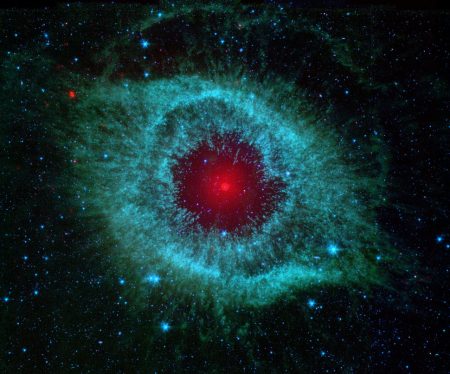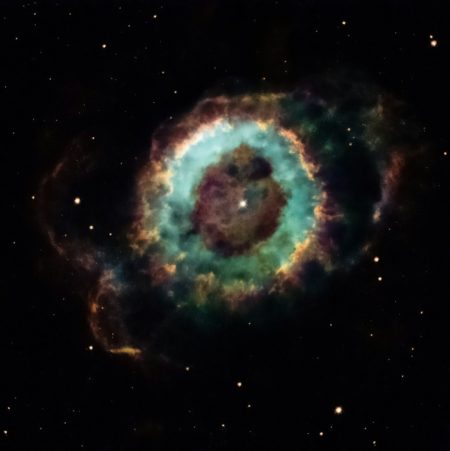
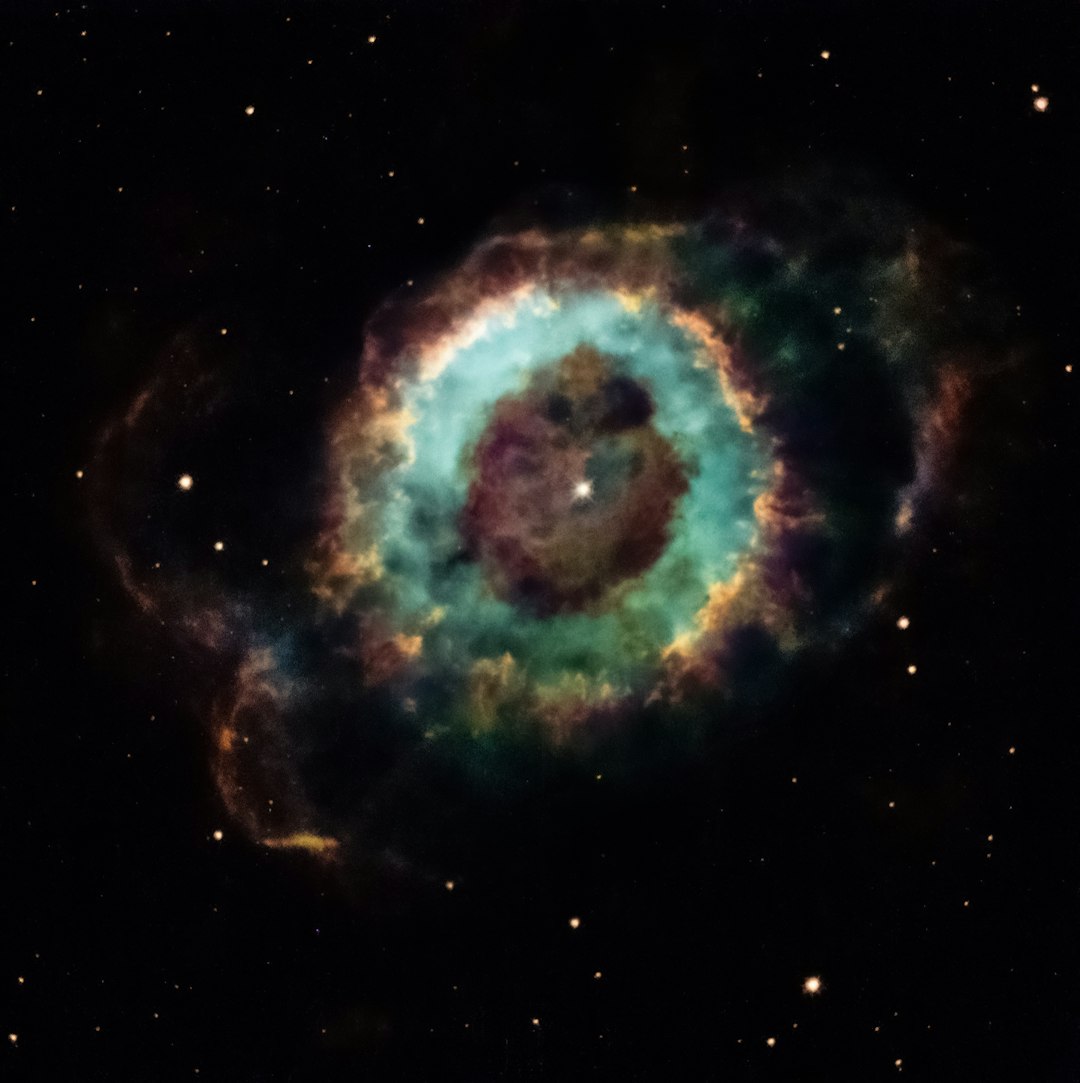
Astronomers have uncovered an immense, previously unseen bar of iron deep within the iconic Ring Nebula, a discovery that challenges current understanding of stellar remnants and planetary nebulae. This colossal structure, found by researchers at University College London and Cardiff University, spans hundreds of times Pluto’s orbit and contains a mass of iron comparable to Mars.
The unexpected finding, reported in the Monthly Notices of the Royal Astronomical Society, provides a fresh perspective on one of the sky’s most famous celestial objects. For decades, the Ring Nebula (also known as Messier 57) has been observed by numerous telescopes, yet this significant feature remained hidden until now. The revelation opens new avenues for exploring the complex processes that unfold during a star’s final stages of life.
This discovery, highlighted in a report by ScienceDaily on January 18, 2026, suggests that our models of stellar evolution and the formation of planetary nebulae might need revision. The sheer scale and composition of the iron bar present a puzzle, prompting scientists to reconsider how dying stars expel their material into space.
Unveiling the Ring Nebula iron bar with new technology
The groundbreaking detection of the Ring Nebula iron bar was made possible by a new instrument called the WHT Enhanced Area Velocity Explorer (WEAVE), specifically its Large Integral Field Unit (LIFU) mode. Mounted on the 4.2-meter William Herschel Telescope, WEAVE’s LIFU uses hundreds of optical fibers to collect spectra across the entire face of the nebula. This allowed astronomers to map its chemical composition in unprecedented detail across all optical wavelengths.
Dr. Roger Wesson, lead author from UCL’s Department of Physics & Astronomy and Cardiff University, explained the significance of the new observations. “Even though the Ring Nebula has been studied using many different telescopes and instruments, WEAVE has allowed us to observe it in a new way, providing so much more detail than before,” Wesson stated. “By obtaining a spectrum continuously across the whole nebula, we can create images of the nebula at any wavelength and determine its chemical composition at any position.”
The clarity of the discovery surprised the research team. “When we processed the data and scrolled through the images, one thing popped out as clear as anything — this previously unknown ‘bar’ of ionized iron atoms, in the middle of the familiar and iconic ring,” Dr. Wesson added, underscoring the instrument’s capability to reveal hidden structures.
Competing theories on its enigmatic origin
The origin of this colossal Ring Nebula iron bar remains a profound mystery, with researchers proposing several intriguing theories. One possibility suggests that the structure preserves new information about the dynamics of how the dying star expelled its material, indicating a more complex or asymmetrical ejection process than previously understood. This could imply a need to refine our models of how stars like our Sun conclude their lives.
Another, more speculative explanation posits that the iron could be the remnants of a vaporized rocky planet. According to this theory, during an earlier, more violent expansion phase of the star, a planet might have been consumed and its core material, rich in iron, dispersed into a curved arc of plasma. Co-author Professor Janet Drew of UCL Physics & Astronomy emphasized the need for more data to discern between these hypotheses. “We definitely need to know more — particularly whether any other chemical elements co-exist with the newly-detected iron, as this would probably tell us the right class of model to pursue,” Drew noted.
The team is now preparing a follow-up study, planning to gather new data at higher spectral resolution using WEAVE’s LIFU. These observations aim to clarify the formation mechanism of the iron bar and identify any accompanying elements, which could provide crucial clues. The ongoing WEAVE project is set to undertake eight major surveys over the next five years, promising further insights into the universe’s many celestial wonders.